
I Bleed First
Why I refuse to turn pain into emotional pablum

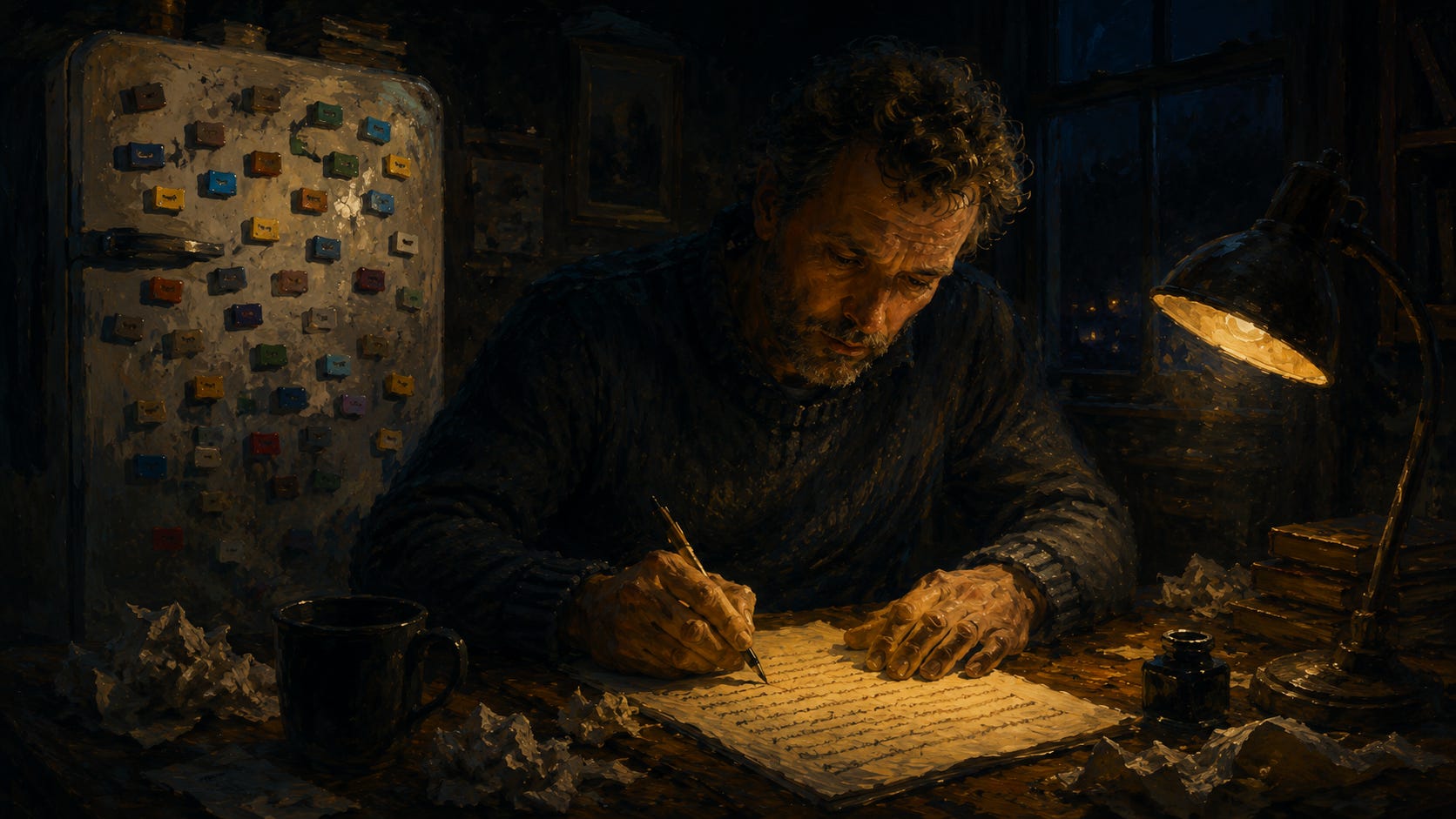
Substack is full of little sentences pretending to be wisdom, the kind of frictionless advice that appears in the feed dressed up as revelation. Build a habit. Create a routine. Learn a skill. Become disciplined. Find clarity. Heal. The words sit there with plenty of white space around them, as if emptiness itself has become a design choice. People like them. They restack them. They nod along as if something meaningful has happened, but most of the time nothing has happened at all.
I don’t hate encouragement. I don’t hate discipline. I don’t hate creation, habits, routines, or the slow work of becoming more than your worst day. I believe in creation. Writing has saved my life more than once.
There have been nights when the only thing standing between me and the abyss was a blank page and the stubborn decision to put one honest sentence after another. But creation is not a slogan, healing is not a checklist, and emptiness is not a productivity problem.
That is where so much of this stuff fails for me. It takes the deep ache of being human and turns it into a calendar entry. It takes grief, loneliness, shame, regret, trauma, heartbreak, abandonment, and the sickening silence of a room where nobody is coming to save you, and it responds with something small enough to fit on a phone screen.
As if the problem was that you simply had not optimized your mornings.
That kind of writing does not bother me because it is technically wrong. Some of it is useful in the same way a cracker is useful when you have not eaten. But it offends something deeper in me because it is too easy. It skips the hard part. It steps around the blood on the floor and calls that wisdom.
The advice feels assembled rather than lived. I could publish a million of these a day by rearranging my refrigerator magnets and posting the results. Create. Heal. Become. Rise. Breathe. Build. Let go. Begin again. Put enough white space around the words and someone will mistake it for revelation.
I can’t write that way. Maybe I wish I could. It would probably be cleaner, easier to sell, easier to digest. I could polish my pain into motivational fragments, arrange them in elegant little stacks, and let readers feel brave without asking them to face anything. But that is not what I came here to do.
What I ask of my readers is harder. I ask them to bleed, but not alone. I bleed first. That is the covenant between me and you, the people who choose to read me. If I am going to write about love, I have to write about the people I failed. If I am going to write about loss, I have to write about the ways I contributed to it. If I am going to write about redemption, I have to be honest about what needed redeeming. I do not get to stand clean and untouched while asking readers to walk through fire.
So I go first. I open the wound honestly, not to make a performance of pain, not to glorify damage, not to turn suffering into theater, but because the only writing that has ever truly mattered to me came from someone willing to tell the truth while their hands were still shaking.
There is a difference between confession and exhibitionism. There is a difference between vulnerability and manipulation. There is a difference between bleeding on the page and bleeding on the reader. I try to know the difference.
I am not interested in naming people to hurt them. I am not interested in dragging private pain into public view for applause. I have no desire to turn my life into a courtroom where everyone I ever loved is called to testify. But I will not pretend everything is fine, because it wasn’t fine. Some of it was beautiful. Some of it was sacred. Some of it still hums inside me like an old song I can’t stop hearing.
But some of it was ugly too. Some of it was selfish. Some of it was reckless. Some of it was the result of wounds I refused to face until they became weapons in my hands.
That is the part the little wisdom posts never seem to touch.
They love the language of becoming. They love growth, clarity, strength, healing, and all the soft-lit aesthetics of transformation. What they rarely ask is what pain made you do, who it made you become, and who paid the price while you were still calling your damage a part of your personality.
That is where real writing begins for me. Not in the clean conclusion, not in the framed quote, not in the tidy moral, but in the place where I can no longer lie to myself.
I have loved badly. I have mistaken desire for devotion, intensity for intimacy, being wanted for being seen. I have let loneliness make decisions that character should have made. I have reached for people as if they were medicine, then acted wounded when they could not cure what I would not confront.
I have been hurt too. Deeply. But pain does not make a person innocent. That is one of the hardest lessons I have ever had to learn. Being wounded does not mean you cannot wound. Being abandoned does not mean you cannot abandon. Being broken does not mean you are incapable of breaking others. That truth is not pleasant, but it is honest, and honesty is the only ground I trust anymore.
I think many readers are tired of being soothed by people who refuse to descend. They are tired of being told to rise while nobody admits what it feels like to be face down on the floor. They are tired of polished little lies that suggest the right habit, the right mindset, or the right morning routine will make the ache disappear. The ache does not disappear that easily.
Sometimes you create while empty. Sometimes you build while grieving. Sometimes the routine does not cure you. It simply keeps you alive long enough to see another morning.
That is survival, and survival deserves better language than slogans.
The kind of writing I believe in does not promise painless healing. It does not hand the reader a ladder from above and tell them to climb. It climbs down into the pit and sits there long enough to say, I know this place too. We may not get out today, but we are not alone down here.
When I write about the women I loved, I am not writing to reopen old wounds for spectacle. I am writing because each of them taught me something I was too immature, too damaged, or too selfish to understand at the time.
Some taught me tenderness. Some taught me danger. Some taught me the difference between hunger and love. Some taught me that being forgiven is not the same as being absolved. Some taught me that love can remain sacred even when the story ends badly.
I carry those lessons because I earned them the hard way, and I also carry the cost. That matters, because without cost, wisdom is just branding. Without consequence, vulnerability is just content. Without blood, the page is only decoration.
I am not here to produce comfort that asks nothing.
I am here for the reader who does not need me to pretend the darkness wasn’t dark. I am here for the reader who has looked back on their life and wondered what the hell they did. Because I am that reader too.
So no, I will not sand the edges off everything. I will not turn my life into motivational oatmeal. I will not pretend that creation cures emptiness just because the sentence looks good in a feed.
Creation does not cure emptiness, at least not at first. At first, creation gives the emptiness somewhere to go: a page, a song, a prayer, a room, a story, a confession. If you return to it honestly enough, long enough, something begins to answer back. Not with easy peace, not with a slogan, but with recognition. Yes, this happened. Yes, it hurt. Yes, you failed. Yes, you were failed. Yes, you are still here.
Healing does not come from pretending the wound is gone. It comes from telling the truth about it, and from refusing to make suffering a solitary thing.
I started to highlight a part I loved, for discussion—then realized I liked another part better, and then another. A riveting piece!
I also am tired of the hollow advice, and particularly for the middle-of-life or older woman. Apparently, we are out there screaming for directional help in our endlessly worthless lives!
And to that I say, not even a little bit! If I had only known when I was younger that you can’t skip over, erase or put the hard things in a box, I would’ve been so ahead of the game.
Every bit of the me you see now happened because I realized I could not step around the blood.
“Healing does not come from pretending the wound is gone. It comes from telling the truth about it, and from refusing to make suffering a solitary thing.”
I resonated with much of this. I think of my story as a window and hope that my writing leaves space to invite others to see themselves in my words.
Your distinction between bleeding on the page and bleeding onto your audience was well stated- restraint is something I work on for this reason. I have so much to learn and don’t really have any sort of intelligent plan. I write from intuition and follow where it takes me.
You also spoke about going first, opening the wound first, and allowing your audience to respond. That kind of writing is so powerful. Thanks for sharing!